What Is Post-Traumatic Growth? (And How Your Worst Chapter Might Be the One That Changes Everything)
Post-traumatic growth is not the same as recovery. Recovery is getting back to who you were before. Growth is becoming someone who could not have existed without the wound. It's one of the most documented and least understood phenomena in trauma research — and it may explain why some survivors don't just heal, but become the most purposeful, honest, and grounded people in any room.
What the Research Actually Shows
Psychologists Richard Tedeschi and Lawrence Calhoun coined the term “post-traumatic growth” in the 1990s after studying survivors of severe adversity — cancer patients, bereaved parents, combat veterans. What they found contradicted the dominant narrative: many people emerged from trauma not just functional, but transformed in ways they hadn't predicted and wouldn't have chosen, but wouldn't trade.
Their research identified five domains in which this growth consistently appeared:
- Personal strength — discovering reserves you didn't know you had
- New possibilities — seeing paths that weren't visible before the crisis
- Relating to others — deeper compassion and connection
- Appreciation for life — a sharpened sense of what actually matters
- Spiritual or existential change — a revised understanding of meaning, purpose, or faith
This is not resilience — the ability to bounce back. Post-traumatic growth involves being changed. The person who comes through is not the person who went in. And while that loss of self is real and sometimes grieved, the new self often carries capacities the old one never had.
The Difference Between Recovery and Growth
One of the most common misreadings of PTG research is the toxic positivity version: everything happens for a reason, your suffering made you stronger, be grateful for your pain.
That's not what the research says. Tedeschi himself has been careful to clarify: post-traumatic growth doesn't mean the trauma was good, necessary, or deserved. It doesn't minimize what happened. It doesn't require gratitude for the wound.
What it says is that the human mind — under the right conditions, with the right support — is capable of making meaning from what has no inherent meaning. And that this process of meaning-making is itself transformative.
The wound doesn't become a gift. But it can become part of a story that changes what you do with the rest of your life.
The Condition PTG Requires: Active Narrative Processing
Here's what matters most about the research: post-traumatic growth doesn't happen automatically. Surviving something hard doesn't guarantee growth. What distinguishes people who grow from people who simply endure is what they do with the story afterward.
Specifically: they tell it. They process it. They find language for what happened, what it meant, and who they became because of it. They construct a narrative that holds both the wound and the wisdom — not separately, but together.
This is sometimes called the narrative bridge: the structure that moves from trauma, through the skills and capacities it forged, toward a future shaped by both. Without the bridge, the trauma is just an event. With it, the trauma becomes part of an identity — one with direction, meaning, and agency.
Your Worst Chapter Is Not the Last One
There's a version of every survivor's story that ends at the worst moment. The divorce. The diagnosis. The deployment. The loss. The rock bottom. Many people live inside that version for years — because the culture around them doesn't have language for what comes after, and because telling the story of the worst moment feels impossible without a container strong enough to hold it.
But the worst chapter is rarely the defining one. What defines a life is usually what happens in the chapter that follows — the one where the person picks something up from the rubble and decides what to do with it.
That chapter is the one most survivors have never had the chance to tell.
How Story Becomes the Container
Rewrite Your Story was built on a simple premise: most people know they have something important to say. They just don't know how to say it. Not because the story isn't there — but because the format of traditional writing makes it inaccessible.
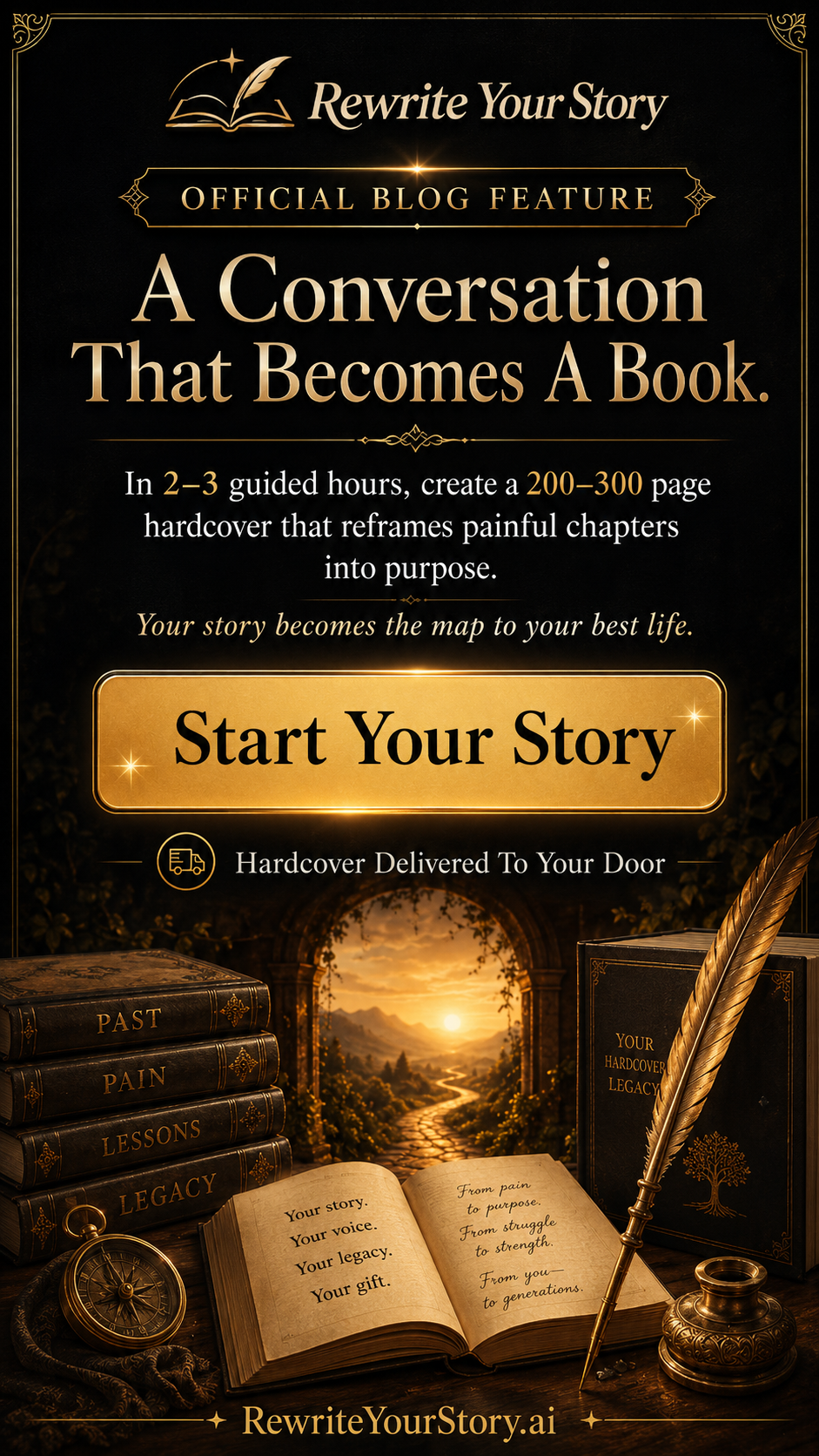
The platform replaces the blank page with a guided conversation. You speak for 2–3 hours with the Scribe — a calm, literary AI guide — moving through seven Passages: origin, formative moments, the turn, the dark chapter, the reckoning, the rebuild, and the meaning.
The Scribe asks questions most people have never been asked about their own lives. Not “what happened” — but “what did that mean?” Not “what did you do” — but “what do you understand now that you couldn't have understood then?”
At the end: a 200–300 page hardcover memoir in your own voice, shaped as a Hero's Journey, delivered to your door. Not a journal. Not a manuscript. A book — the kind that sits on a shelf and outlasts you.
The Book as Evidence of Growth
There is something that happens when a person reads their own story — shaped, structured, named — that cannot happen any other way. The narrative bridge, finally built. The wound visible not as a wound, but as a turning point. The worst chapter legible not as defeat, but as the chapter that made the next one possible.
That's what post-traumatic growth looks like when it's held in your hands.
And with every book created, a second journey is given free — to a veteran, a woman starting over, or someone in recovery. One story rewritten. One story made possible for someone who couldn't otherwise access it.
What happened to you is permanent. What it means is not.
If you've survived something that changed you — and you're still trying to figure out what it means — you're not stuck. You're at the beginning of the most important chapter. You don't need to write a word. You just need to speak.
“What happened to you is permanent. What it means is not.”
Rewrite Your Story turns 2–3 hours of guided speaking into a 200–300 page hardcover memoir — delivered to your door. No writing required. You keep copyright and film rights.
Begin Your Story →By Brian Kiplinger — Founder, Rewrite Your Story. Not a therapist, just a guy who built a tool he wishes existed.