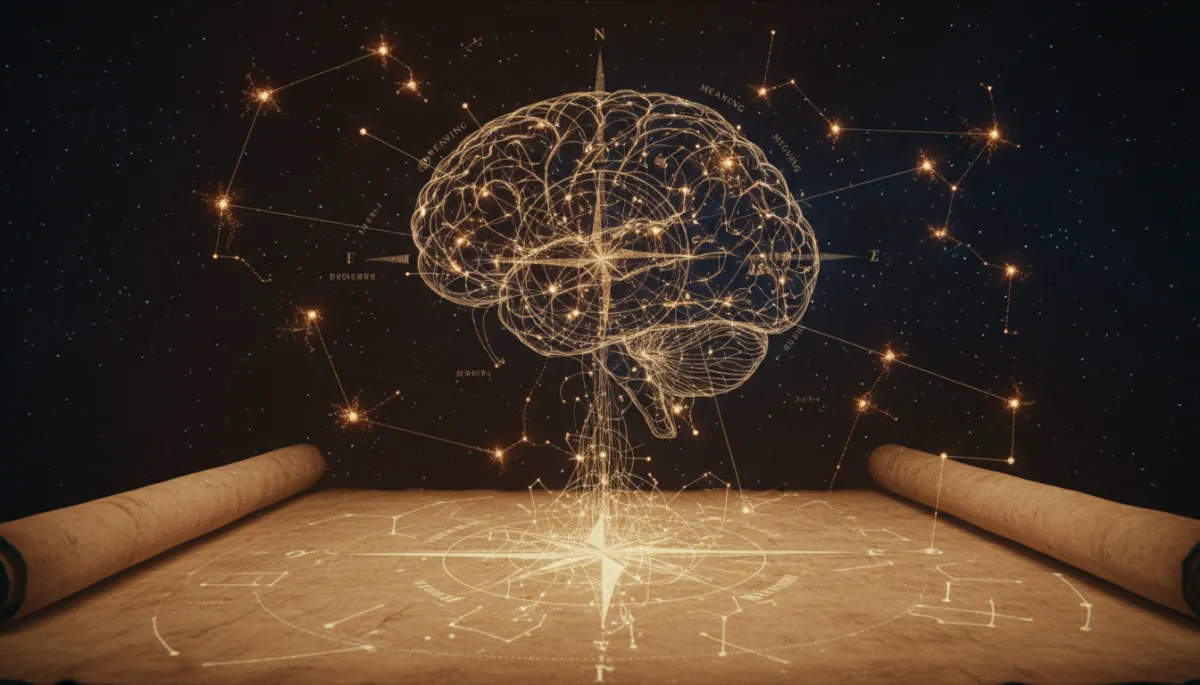
The Science of Meaning-Making: Why Your Brain Needs a Story to Heal
There is something the brain does with trauma that no one tells you about at the beginning: it obsesses over it. Not because you're weak or broken, but because the brain has a specific job to do when something devastating happens — and it cannot stop until that job is finished.
The job is meaning-making. And until it has a coherent story, it will keep returning to the wound.
Why Your Mind Keeps Going Back
Trauma disrupts what psychologists call narrative identity — the running story of self that each of us uses to organize experience and understand who we are. Under normal circumstances, your brain integrates events into a coherent timeline: this happened, then that, and I am the person those things made me.
Trauma interrupts that process. The event is too large, too sudden, or too contradictory to integrate cleanly. The result is what researchers call an “unfinished story” — and the brain, like a book left open to a chapter it can't finish, keeps returning to the same pages.
This is not weakness. This is the brain doing its job with incomplete materials.
What Meaning-Making Actually Is
Meaning-making is not the the same as finding a silver lining. It is not toxic positivity. It is not being told “everything happens for a reason” by someone who has not been through what you've been through.
Meaning-making is the process of building a coherent, honest story out of what happened — one that answers the questions the brain keeps asking:
- Why did this happen to me?
- What does this say about who I am?
- What kind of future is still possible?
- What was I supposed to do with this?
The answers don't have to be clean. They don't have to be uplifting. They just have to be true — and they have to be yours.
Research by psychologists Crystal Park and Susan Folkman distinguishes between two levels of meaning-making: situational (what does this specific event mean?) and global (what does it mean about life, about me, about the world?). Both need resolution. And both require language — story — to achieve it.
Why Telling the Story Works
Decades of research on expressive writing and narrative therapy converge on the same conclusion: telling the story changes the story.
Not the facts. The facts stay the same. What changes is the meaning you assign to them, the emotional charge they carry, and crucially, your relationship to yourself as the person who lived through them.
When you tell your story — fully, honestly, to someone who is genuinely listening — something structural happens in the way the brain processes it. The event moves from implicit, emotionally volatile memory toward explicit, narrative memory. It doesn't disappear. But it stops running the show from backstage.
The Epiphany Isn't in the Facts — It's in the Framing
One of the most consistent observations from the Rewrite Your Story process is the moment, usually mid-conversation, when a survivor reframes a piece of their story in a way that changes everything:
- “I wasn't difficult. I was dysregulated.”
- “I wasn't weak. I was overwhelmed.”
- “I wasn't cursed. I was repeating familiarity.”
These aren't platitudes. They are genuine shifts in meaning — and they happen not through journaling, not through meditation, not through therapy alone, but through the act of speaking the story aloud to a guide who knows which questions to ask.
The brain doesn't complete its meaning-making work in isolation. It needs an audience. It needs to be heard. We are social animals who have always processed our most important experiences through story, shared with others.
The Narrative Bridge
What meaning-making ultimately builds is a coherent arc that connects who you were before, who you became during, and who you are capable of being after.
Trauma → Skill → Future Application.
The woman who survived a difficult childhood didn't just survive — she developed an extraordinary capacity for reading emotional dynamics, for staying calm under pressure, for finding the exits in any room. The veteran who came home didn't just lose a career — he developed clarity of purpose and a capacity for loyalty that most civilians never build. The Narrative Bridge doesn't erase what happened. It makes it mean something worth carrying.
Your Story Deserves to Last
Turn Your Life Into a Hardcover Memoir — Without Writing a Word
A 2–3 hour guided conversation. An AI Scribe. A 200–300 page book delivered to your door.
Start Your Story →The Book Is the Meaning
This is why Rewrite Your Story exists in the form it does — not as a journaling platform, not as a therapy alternative, not as a writing course — but as a process that results in a permanent, physical object.
Because the brain's meaning-making work isn't complete until the story is fixed. Until it exists in a form that says: this happened, this is what it meant, and I am the person who lived it and lived through it.
A 200–300 page hardcover memoir, in your voice, in your words, delivered to your door, is not a vanity project. It is the culmination of the meaning-making process — the moment the brain can finally close the chapter it has been holding open.
You speak. The Scribe listens and writes. The book arrives. And something that has been unresolved for years — sometimes decades — finally has a form.
You Don't Have to Understand It to Begin
The meaning-making process doesn't require you to have the answers before you start. The answers almost never come before the story begins — they come during it. The act of telling is how the understanding arrives.
You don't need to know what your story means. You just need to be willing to tell it.
“What happened to you is permanent. What it means is not.”
Rewrite Your Story turns 2–3 hours of guided speaking into a 200–300 page hardcover memoir — delivered to your door. No writing required. Founding edition $397 · 30-day refund · You keep copyright and film rights.
Begin Your Story →By Brian Kiplinger — Founder, Rewrite Your Story. Not a therapist, just a guy who built a tool he wishes existed.